
Your first days on a snowboard are the hardest part of the sport. You will fall more than you expect, your legs will burn in places you did not know you had, and at some point on day one you will wonder why you did not just book ski lessons. Then, usually on day two or three, something clicks: you link two turns, then four, and you are hooked. This guide explains what really happens in those first days, how to set yourself up for them and how to learn faster, from instructors who teach beginners in Niseko every winter.
The short version: Book a lesson for at least your first two days, rent boots that actually fit, wear a helmet and wrist guards, start on the gentlest terrain you can find and expect to link your first turns somewhere between day two and day three.
In this guide
Before day one: set yourself up to succeed
- Boots matter more than the board. Ask the rental shop for soft, comfortable boots and walk around in them before you leave. Your heel should not lift when you lean forward. Sore, loose boots are the most common reason beginners have a miserable first day.
- Find out if you ride regular or goofy. Regular means left foot forward, goofy means right foot forward. A quick test: slide across a smooth floor in socks, or have someone give you a gentle push from behind. The foot you put forward to catch yourself is usually your front foot.
- Wear a helmet and wrist guards. Beginners fall backwards and forwards onto their hands a lot. More on why below.
- Dress for the cold, not for fashion. Waterproof pants, warm gloves and a neck warmer. You will spend a lot of time sitting in the snow. See what to pack for Japan.
- Book a lesson in advance. In peak weeks in Niseko, lessons fill up. Two half-days or two full days at the start of your trip is the sweet spot.
What really happens in your first days
Everyone learns at a different speed, and conditions matter a lot. But this is the progression we see most often with adult beginners in a good lesson.
| Day | What you learn | What it feels like |
|---|---|---|
| Day 1 (morning) | Strapping in, skating with one foot, gliding straight, stopping | Awkward. Lots of sitting down |
| Day 1 (afternoon) | Side slipping on your heel edge, “falling leaf” left and right | Tiring, but you start to feel the edges |
| Day 2 | Toe edge side slip, first J-turns, then linking a turn in each direction | The hardest day, and the one where it clicks |
| Day 3 | Linking turns on gentle green runs, riding the chairlift | You are snowboarding |
| Days 4–5 | Controlling speed, rounder turns, easy blue runs | Confidence grows quickly |
Day one: balance, gliding and stopping
You will start with one foot strapped in, skating along the flat and gliding short distances, a bit like a skateboard. Then both feet in, standing up, and learning to stop by pressing on your heel edge. By the afternoon most people can side slip down a gentle slope facing downhill, and do a “falling leaf”: drifting left and right across the slope on one edge without turning.
Day two: the turn
Day two is about the toe edge (facing uphill) and the moment of changing from one edge to the other. This is where most falls happen, because the edge change feels unnatural at first. Your instructor will build it up in small steps: J-turns that finish across the slope, then a turn from heel edge to toe edge, then back again. When you link your first two turns, you will feel it.
Day three: linking turns and the chairlift
On day three most beginners are linking turns on gentle green runs and riding a chairlift with one foot strapped in. From here, the more miles you ride, the faster you improve.
Not linking turns by day three? That is completely normal. Fear, tiredness, ill-fitting boots and bad visibility all slow things down. Take a break, eat something and go back to the exercise that last felt easy.
Instructor’s note
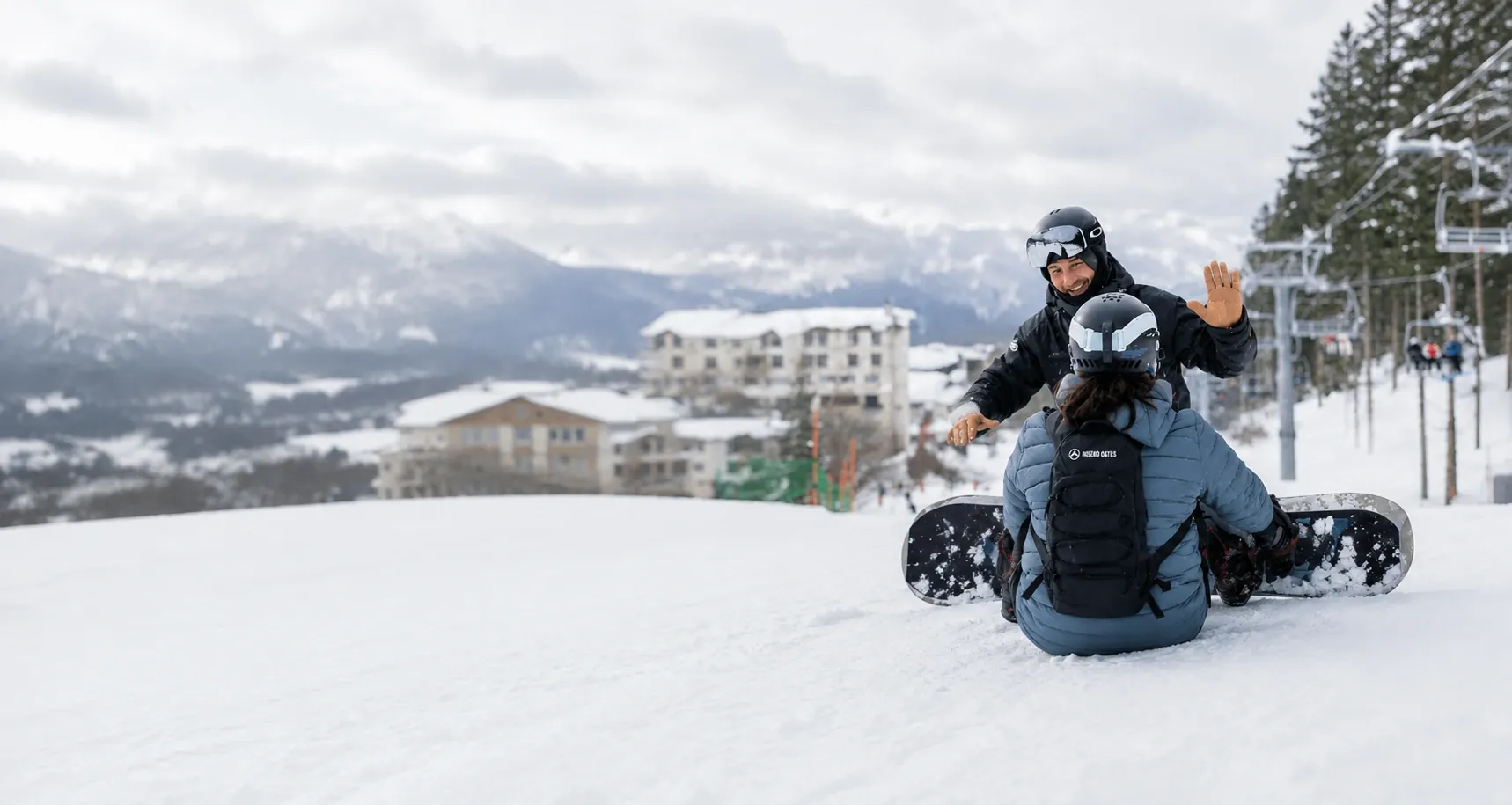
This is how a first day usually goes with us in Niseko. We start at the base of the Ace lifts in Grand Hirafu until the student can move confidently with one foot strapped in, then head to the Family run. With more than one beginner the process is slower, and everyone needs a little autonomy before we ride the chairlifts together.
The three things we repeat all day: do not look at the ground, keep your back straight, and use your body position, not your ankles, to do the work. Good posture is what makes you effective and stops you from getting exhausted.
How to fall without getting hurt
Wrist injuries are among the most common snowboarding injuries, and beginners are most at risk because they fall a lot and instinctively put a hand out. In a randomised trial of more than 5,000 snowboarders, those wearing wrist protectors had far fewer wrist injuries (8 against 29 in the group without them).
- Falling backwards: make fists, tuck your chin, sit down onto your bottom and roll onto your back. Do not reach back with open hands.
- Falling forwards: drop onto your knees and then your forearms, not your straight arms.
- Wear a helmet. Catching the toe or heel edge on a hard slope can throw you onto the back of your head.
- Stop at the side of the run, where people above can see you, never just below a roll.
Getting on and off the chairlift
- Ride with your front foot strapped in and your back foot free.
- Hold your board pointing straight ahead as you sit down, and lower the safety bar if there is one.
- To get off, put your free back foot on the board against the back binding, stand up as the chair reaches the ramp and let the board glide straight. Look ahead, not down.
- If you fall at the top, move out of the way as quickly as you can. It happens to everyone.
Why a lesson is worth it (especially in Japan)
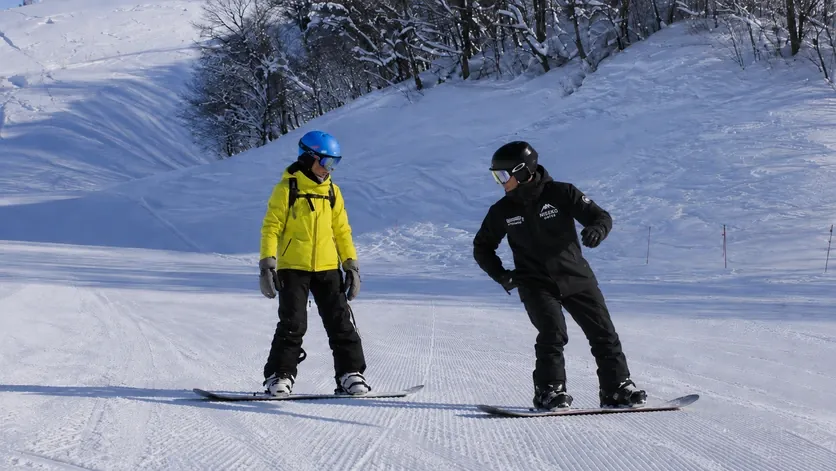
Learning from a friend often ends in frustration on both sides. A good instructor breaks every move into small steps, chooses the right terrain for each one and fixes the small mistakes that cause most falls. Most people progress much faster with a lesson in the first two days, and they enjoy it more.
Niseko is also one of the best places in the world to learn. All four Niseko United resorts have dedicated beginner areas with gentle slopes and magic carpets, and the snow is soft, so falls are gentler than on the icy slopes many people learn on at home. At Grand Hirafu, the long, wide “Family” run at the base of the village is a classic next step after the magic carpet, and Annupuri has wide, gentle slopes at the bottom of the mountain. Check the current trail map, because lifts and run names can change from season to season.
Common beginner mistakes
| Mistake | What happens | Fix |
|---|---|---|
| Looking down at the board | You lose balance and turn late | Look where you want to go |
| Leaning back | The board runs away and you cannot turn | Weight over the front foot, knees bent |
| Straight legs | Every bump knocks you over | Bend your knees and ankles, stay low |
| Turning with the arms | You twist and catch an edge | Turn with your hips and legs, hands calm |
| Going too slow in deep snow | The board sinks and stops | On powder days, stay on groomed beginner runs |
| Riding until exhausted | Most falls happen when you are tired | Short sessions, regular breaks, water and food |
What about powder?
Everyone comes to Japan for the powder, but deep snow is not the place to learn your first turns. Stay on groomed runs until you can link turns comfortably and stop when you want. Then try the soft snow at the edge of the groomers and read how to snowboard in powder. Never go into the trees on your own: read our tree well safety guide first.
Learn to snowboard in Niseko
Private beginner lessons with local instructors who teach first-timers every day of the season, from the magic carpet to your first linked turns.
Frequently asked questions
How long does it take to learn to snowboard?
Most adults link their first turns somewhere between day two and day three with good lessons. Riding green and easy blue runs with confidence usually takes about a week.
Is snowboarding harder than skiing?
The first days are usually harder on a snowboard, because you fall more and both feet are fixed to one board. Many people find it easier to progress after that.
Should I take a group or private lesson?
Both work. Private lessons progress faster and adapt to you; group lessons are cheaper and more social. If you only have a few days, a private lesson on day one is the best investment.
Do I need wrist guards?
They are strongly recommended for beginners. A randomised trial found far fewer wrist injuries among snowboarders who wore them.
Can I learn to snowboard in Niseko?
Yes. All four resorts have beginner areas, magic carpets and ski schools, and the soft snow makes falls gentler.
Sources and official links
- Niseko United: why Niseko is a great place to learn to ski and snowboard
- Niseko United: lifts, tickets and season dates
- The efficacy of wrist protectors in preventing snowboarding injuries (Am J Sports Med, 2001)
Last checked: October 2026. Lift prices, dates and transport change every season, so always confirm with the official sites before you travel.

Snowboard instructors and guides who ride and teach in Niseko every winter. What we write comes from days on the mountain with our students. More about Snowboard Niseko.