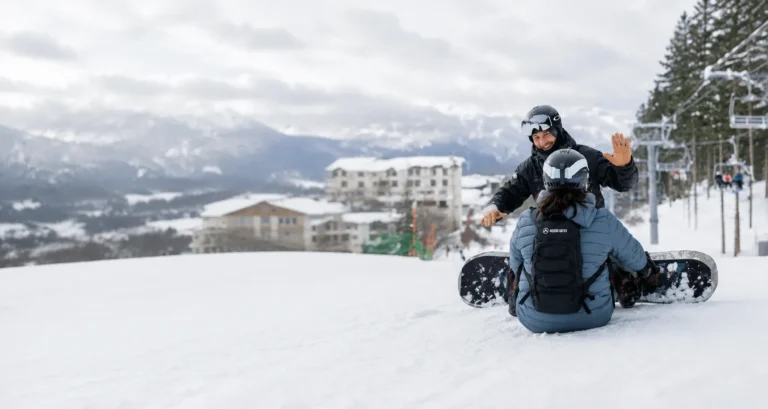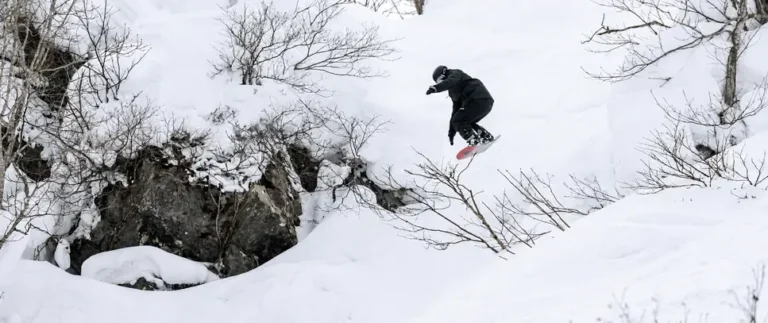

Japan’s deep snow and birch forests make for some of the best tree riding in the world. They also hide one of the most serious risks in snowboarding: tree wells. Every season, riders in Japan get trapped in deep snow near trees. Knowing what tree wells are, how to avoid them and what to do if you fall in can save your life, or your friend’s.
Key rule: Always ride with a partner, stay in sight of each other and stop often. Most tree well deaths happen to people who were riding alone or got separated from their group.
In this guide
What is a tree well?
A tree well is a hollow of loose, unconsolidated snow around the base of a tree. Branches stop snow from settling evenly around the trunk, so a deep, soft hole forms under the surface. You often cannot see it from above.
If you fall head-first into a tree well, the loose snow collapses around you and the more you struggle, the deeper you sink. This is called snow immersion suffocation (SIS), and it can kill as quickly as drowning.
| Fact | What the research says |
|---|---|
| Self-rescue | In two North American experiments, 90% of volunteers placed in tree wells could not get themselves out |
| Where deaths happen | About two thirds of US snow immersion deaths over a nine-year study happened in tree wells |
| When the risk is highest | During and right after heavy snowfall, which is exactly when Japan’s trees are best |
| Who survives | People whose partner sees them go in and starts digging immediately |
Why tree wells matter in Japan
Japan gets a lot of snow, and in the heart of winter it falls light and deep. That creates exactly the conditions where tree wells form and where riders spend most of their time on storm days: in the trees. Deep-snow areas with conifers are the highest risk, but deep snow anywhere can trap a rider who falls head-down.
How to avoid tree wells
- Ride with a partner and keep visual contact. Your partner should always be able to see you, and you them.
- Use the “buddy system” properly. Ride one at a time through tight trees, with one person watching from below or above.
- Give trees space. Aim for the gaps, not the trunks. Look at where you want to go.
- Control your speed. Ride at a pace where you can stop or turn away from a tree.
- Stop often to regroup. Agree on regroup points before you drop in.
- Carry communication. A whistle and a charged phone can help partners find each other.
What to do if you fall into a tree well
- Try not to go in head-first. If you are falling, grab branches or the trunk to stay upright.
- Protect your airway. If you are going in head-first, bring your arms up to make a space around your face so you can breathe.
- Stay calm. Struggling packs the snow around you and makes it worse.
- Rock gently. Slowly rock your body to create space and pack the snow, rather than thrashing.
- Call for help. Use your whistle, phone or voice. Trust that your partner is looking for you.
How to rescue a partner
If your partner falls into a tree well, act immediately. Do not leave to get help unless there is no other option. Call for help, then dig. Approach from the side, not from directly above, so you do not collapse more snow onto them. Clear the airway first, then dig them out.
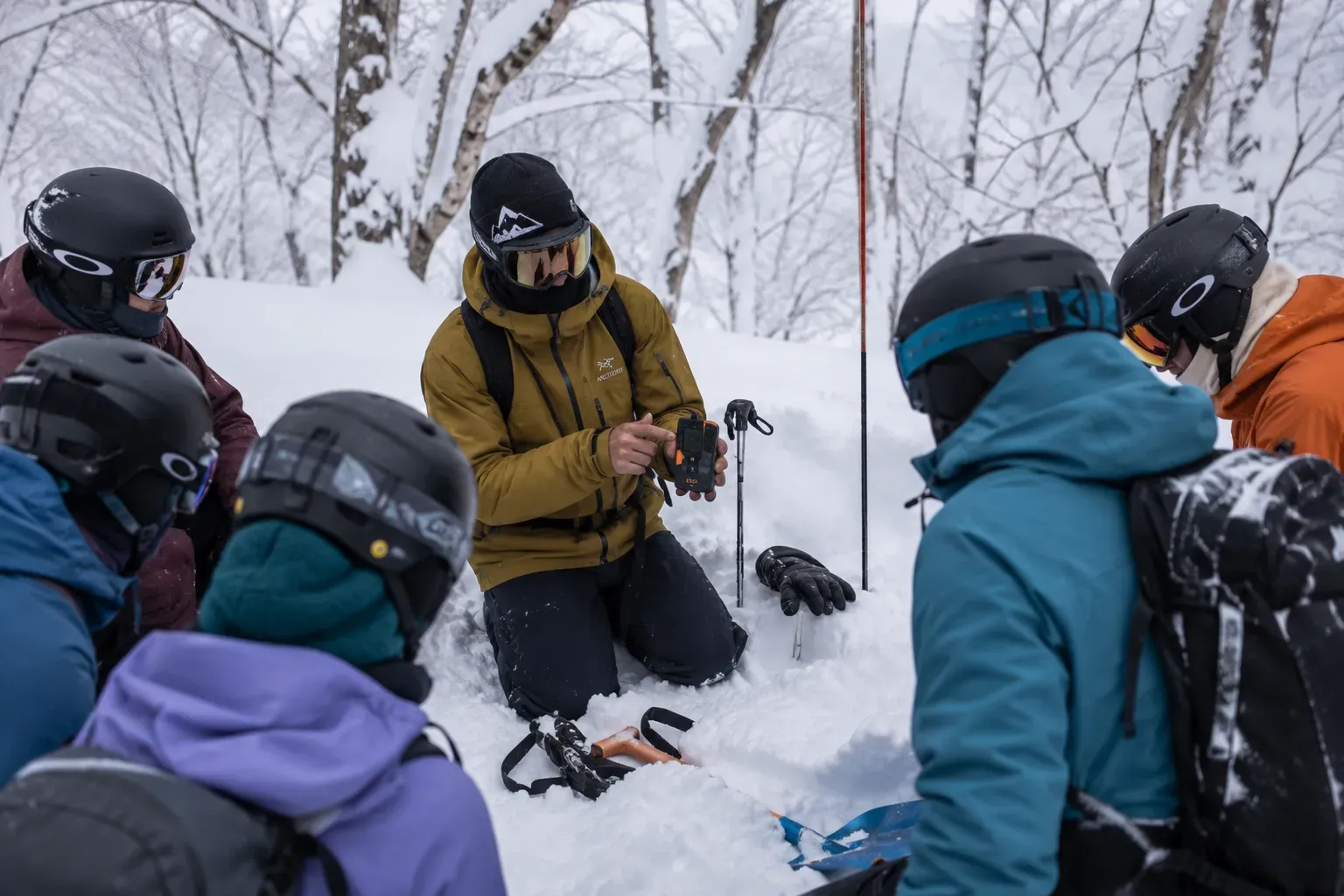
Carrying a shovel and knowing how to use it is just as important in the trees as in avalanche terrain. Read riding the Niseko gates on a snowboard for the full list of safety gear.
Avalanche gear is not just for the backcountry. A beacon, shovel and probe speed up any snow burial rescue, and they let your partners find you if you disappear in the trees.
Instructor’s note
In Niseko, more than tree well scares, what we actually see most are collisions with trees, usually from riding faster than the terrain allows.
In spring there is another hazard: glide cracks, open cracks in the snowpack that form as the snow warms and slowly slides over the ground. They can be deep, so give them a wide berth.
Learn to ride trees safely
Tree riding is a skill. Learning how to read the trees, choose lines and manage your speed makes it safer and much more fun. Our guide to how to snowboard in powder is a good place to start.
Learn tree riding with a local instructor
Freeride coaching in Niseko focuses on safe tree riding, terrain reading and partner skills for deep snow.
Tree well FAQ
Are tree wells common in Japan?
Yes. Japan’s deep snow and tree-filled terrain create the conditions for tree wells, especially in mid-winter after big snowfalls.
Can tree wells form inside the resort?
Yes. Tree wells can form anywhere there is deep snow and trees, including in-bounds tree runs and the edges of groomed runs.
Can you get out of a tree well on your own?
Usually not. In experiments, 90% of volunteers could not self-rescue. That is why riding with a partner who keeps you in sight matters more than anything else.
Should I carry avalanche gear in the trees?
It is a good idea. A beacon, shovel and probe speed up any burial rescue, and a whistle helps your partners locate you. Behind the Niseko gates, a helmet and beacon are required.
Sources and official links
- Deep Snow Safety: what is snow immersion suffocation
- Tree well (overview and research)
- The Niseko Rules
Last checked: October 2026. Lift prices, dates and transport change every season, so always confirm with the official sites before you travel.

Snowboard instructors and guides who ride and teach in Niseko every winter. What we write comes from days on the mountain with our students. More about Snowboard Niseko.