
Riding powder is the reason most snowboarders come to Japan. It is also where a lot of riders struggle for the first few days: sinking, catching the nose, burning their back leg and falling every few turns. The good news is that powder is easier on a snowboard than on skis once a few things click.
These tips come from teaching powder in Niseko every winter. Work through them in order.
The short version: Keep your speed, keep your weight centred over a slightly setback stance, steer with your back foot and make smooth, rounded turns instead of sharp edge changes.
In this guide
- 1. Set up your board for powder
- 2. Speed is your friend
- 3. Stay centred, do not sit back
- 4. Steer with your back foot
- 5. Make round, smooth turns
- 6. Use your whole body to unweight
- 7. Look ahead, not down
- 8. Avoid flat spots and traverses
- 9. Know how to get up in deep snow
- 10. Ride with a partner and stay in sight
- Powder drills for your first days
- Common mistakes in powder
- Is it worth taking a powder lesson?
- Powder FAQ
1. Set up your board for powder
Before you ride, move your bindings back on the inserts if your board allows it. A setback stance lifts the nose naturally, so you do not have to lean back to keep it up. If you are renting, ask for a directional or powder board, or at least a board slightly longer than you would use on groomers.
Instructor’s note
The change that helps most riders on their first powder morning is not technique at all: it is moving the bindings back and committing to more speed. Nearly everyone who “can’t ride powder” is riding too slowly and leaning back to compensate.
2. Speed is your friend
Deep snow slows you down fast. If you ride too slowly, the board sinks and you have to fight to get it back up. Point it a bit straighter than you would on a groomer and let the board build speed. Speed creates float, and float makes turning easy.
3. Stay centred, do not sit back
Many riders try to keep the nose up by leaning back. It works for a few seconds, then your back leg burns out and you lose control. Stand tall over the middle of the board, knees bent, and let the setback do the work. Use a little extra pressure on your back foot only when you need it.
4. Steer with your back foot
In powder, the tail acts like a rudder. Instead of rolling quickly from edge to edge, twist and push your back foot around to steer the board through the turn. Think of a surfer steering with the tail.
5. Make round, smooth turns
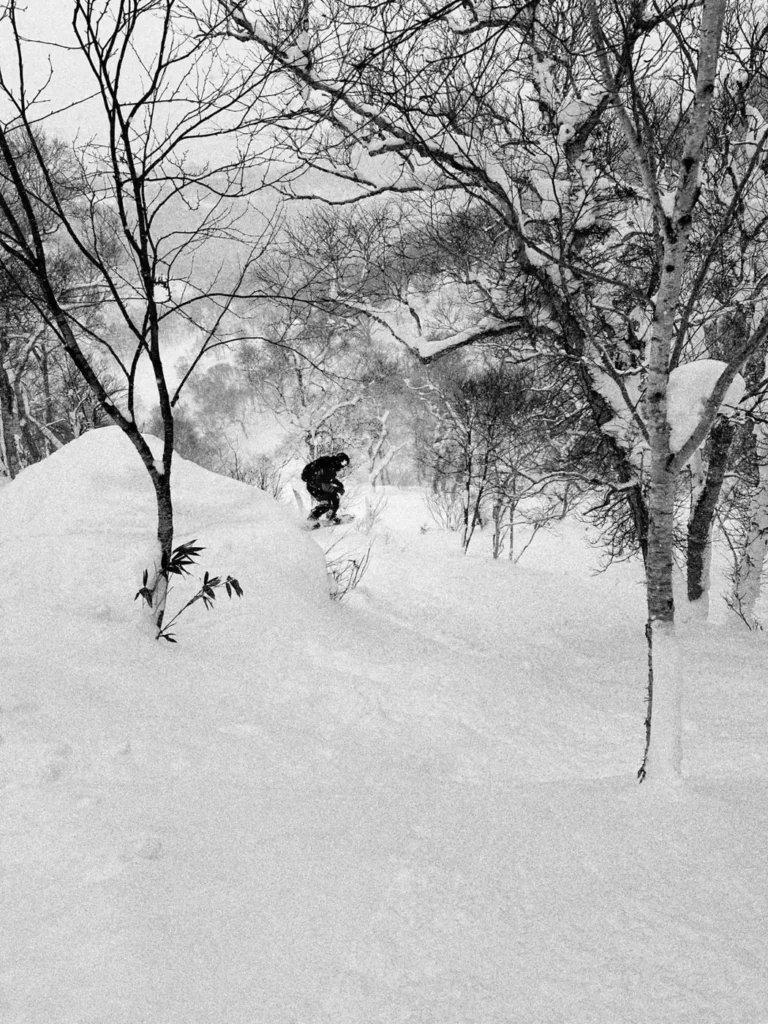
Sharp, quick edge changes make the board dive. Long, round, “C”-shaped turns keep the board on top of the snow. Start each turn slowly, let it build through the middle and finish it smoothly. Rhythm matters more than power.
6. Use your whole body to unweight
At the end of each turn, rise up a little to lighten the board, then sink into the next turn. This up-and-down movement helps the board come to the surface and makes the edge change easier.
Instructor’s note
We describe a good powder turn as a dolphin. The board dives into the snow at the start of the turn and comes back up to the surface at the edge change, when you unweight it: a down-unweighted turn. Sink into the turn, let the snow push you back up and change edges while the board is light. Riders who get this stop fighting the snow and start floating.
7. Look ahead, not down
Look where you want to go, two or three turns ahead. In trees, look at the gaps, not at the trunks. Your board follows your eyes.
8. Avoid flat spots and traverses
Snowboards hate flat powder. Before you drop in, look at where the run goes and whether it flattens out. Carry speed into flat sections and avoid long traverses where you could get stuck and have to unstrap.
9. Know how to get up in deep snow
You will fall. Everyone does. In deep snow, pushing on the snow with your hands just sinks your arm. Instead, roll onto your stomach, bring the board downhill of you, and push up from your knees. If you are very stuck, make a platform by packing snow with your hands, or cross your arms to spread your weight.
10. Ride with a partner and stay in sight
This is the most important tip on the list. Deep snow and trees bring the risk of tree wells, where a fallen rider can get trapped head-down. Always ride with a partner, stay in sight of each other and stop often to regroup. Read our full guide to tree well safety.
Powder drills for your first days
- Straight runs: On a gentle powder slope, ride straight and practise moving your weight forward and back to feel how the nose rises and sinks.
- Falling leaf: Slide across the slope on your heel edge, then toe edge, to feel how the board moves in deep snow.
- Big turns: Link three long, slow turns on an easy slope before trying steeper terrain.
- Groomer edges: Practise at the side of a groomed run, where fresh snow collects, before heading into the trees.
Common mistakes in powder
These are the five mistakes we correct most often in powder lessons in Niseko:
| Mistake | What happens | Fix |
|---|---|---|
| Sitting back | Your back leg burns and you lose steering | Centre your weight and set your bindings back |
| Closing every turn too much | You bleed speed and the board sinks | Keep the turns more open and let the board run |
| Stiff legs | The board bounces and dives instead of flowing | Flex and extend: sink into the turn, rise out of it |
| No planned line | You react late and end up in flats or tight spots | Plan the next two or three turns before you drop in |
| Looking at your feet | Late turns and lost balance | Eyes up, on the line you are about to ride |
Is it worth taking a powder lesson?
If you only get a few days in Japan, a lesson on your first morning can save the rest of the trip. A good instructor will fix your stance, show you where the snow is best that day and help you skip the frustrating learning curve.
Learn to ride powder in Niseko
Private snowboard lessons and freeride coaching with local instructors who teach in deep snow every day of the season.
Instructor’s note
Two kinds of riders surprise themselves most in our powder lessons. The first arrives very sure of their level, meets more than half a metre of fresh snow and struggles all morning: plenty of motivation, not enough technique.
The second has ridden for years with small habits that cost a lot of energy. Once they understand how the board actually works in deep snow, they tire less, ride for longer and finish the day grinning. Getting down a slope and understanding what your board is doing are two very different things.
Powder FAQ
Is powder easier on a snowboard or skis?
Most people find it easier on a snowboard once they have the basics, because the wide board floats more easily. The first few days can still be hard work.
Do I need a special powder board?
No, but it helps a lot. A directional shape, setback stance and a slightly longer or wider board all make deep snow easier. See our guide to what to pack for Japan.
Why does my back leg hurt in powder?
You are probably leaning back to keep the nose up. Set your bindings back, stand more centred and keep your speed up so the board floats on its own.
Can beginners ride powder in Japan?
Yes. Start on gentle slopes and the edges of groomed runs. Light Japanese powder is forgiving, and falling in it is soft. A lesson will speed up the process.
Written and reviewed by snowboard instructors who teach powder and tree riding in Niseko every winter. Last reviewed: October 2026.

Snowboard instructors and guides who ride and teach in Niseko every winter. What we write comes from days on the mountain with our students. More about Snowboard Niseko.