
Tree riding is where Japan’s snowboarding really comes alive. On storm days the trees hold the deepest snow and give you visibility when the open slopes are a white-out. But trees also punish bad habits fast. This guide covers how to ride trees on a snowboard with confidence and control.
Safety first: Tree riding in deep snow carries the risk of tree wells. Always ride with a partner and stay in sight of each other. Read our tree well safety guide before you start.
In this guide
- Before you go into the trees
- 1. Look at the gaps, not the trees
- 2. Control your speed with turn shape
- 3. Ride a slightly more upright, ready stance
- 4. Make shorter turns
- 5. Use the terrain
- 6. Protect your face
- 7. Stop in the right place
- 8. Ride with a system
- Tree riding drills
- Where to practise in Japan
- FAQ
Before you go into the trees
- Be comfortable in powder. If deep snow still feels like a fight, start with how to snowboard in powder.
- Choose well-spaced trees. Start where the gaps are wide and the slope is moderate.
- Know where the run goes. Trees can hide flats, creeks and cliffs. Ride lines you know, or follow someone who does.
1. Look at the gaps, not the trees
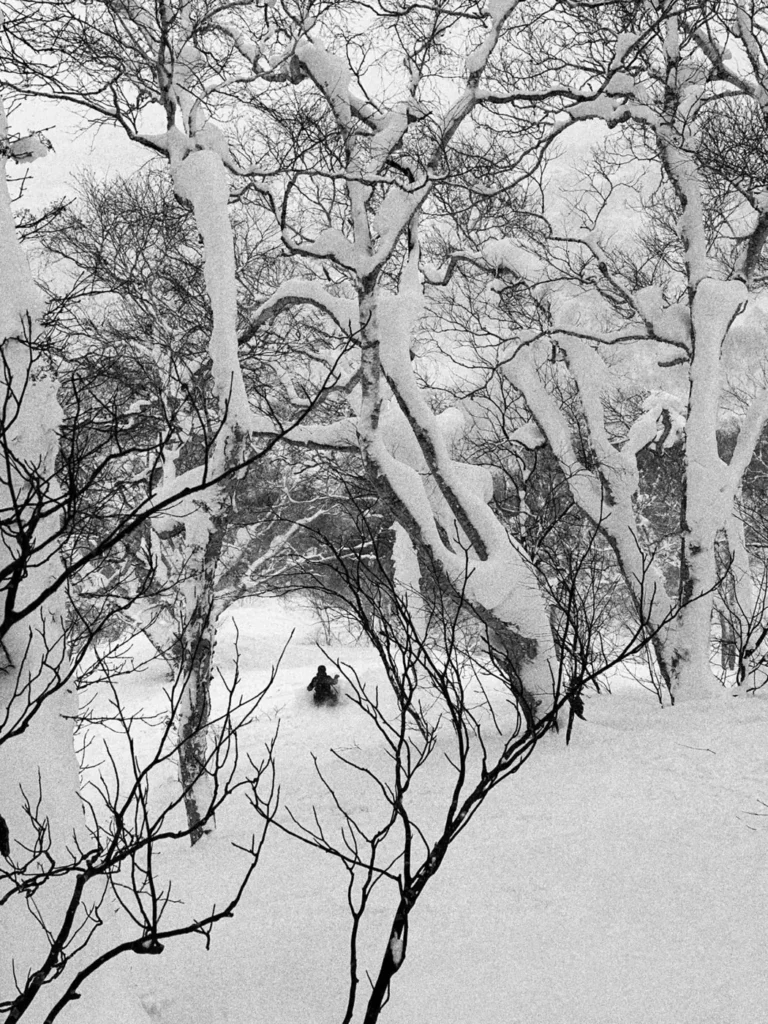
This is the golden rule. Your board goes where your eyes go. If you stare at a trunk, you will ride toward it. Look for the white spaces between the trees and plan two or three turns ahead.
Instructor’s note
When we take riders into the trees for the first time, we start on wide, well-spaced trees on a gentle pitch and ask them to say the gap out loud before each turn. It sounds silly, but it forces your eyes onto the space instead of the trunk.
Instructor’s note
We tell our students that trees are like problems: if you stare at them, you attract them. Look at the white gaps and keep your eyes on the line you are about to ride, two or three turns ahead.
2. Control your speed with turn shape
In the trees you need to be able to stop or change direction at any moment. Instead of skidding to control speed, finish your turns more across the slope. Rounder, more complete turns keep your speed steady.
3. Ride a slightly more upright, ready stance
Keep your knees bent, hands in front and shoulders facing down the fall line. A relaxed, athletic stance lets you react to bumps, branches and sudden changes.
4. Make shorter turns
Long, sweeping turns work on open slopes. In the trees, short, rhythmical turns let you fit through the gaps. Practise linking quick turns on an open powder slope first.
5. Use the terrain
Trees often create natural features: pillows, small drops, gullies and banks. Use them to turn and slow down. Do not hit anything you have not looked at first.
6. Protect your face
Low branches are everywhere in Japanese birch forests. Wear a helmet and goggles, keep your hands up and duck when you need to.
7. Stop in the right place
When you stop, choose an open spot below or beside a tree, never right above a trunk. Stop where your partner can see you.
8. Ride with a system
- Agree on regroup points before you drop in.
- One person rides, the other watches until they stop.
- Call out to each other regularly.
- Never ride alone in the trees.
Instructor’s note
On a first day in the trees we see the same three mistakes again and again: staring at the trunks, starting too fast or out of control, and trying to squeeze through gaps that are too tight.
Our group rules are simple: keep visual contact at all times, and never stop on a flat spot in deep powder, because getting going again can take a long time.
Tree riding drills
| Drill | Why it helps |
|---|---|
| Linked short turns on open powder | Builds the rhythm you need in the trees |
| “Gate” practice between two trees | Teaches you to look at the gap, not the trunks |
| Speed checks on a moderate slope | Learn to slow down with turn shape, not skidding |
| Follow the leader | Copy a better rider’s line and rhythm |
Where to practise in Japan
Niseko, Rusutsu, Kiroro and Hakuba’s Cortina all have excellent tree riding. Start on in-bounds tree runs before heading anywhere near the side-country.
Learn tree riding with a coach
A freeride session with a local instructor is the fastest way to ride trees with confidence and safety.
FAQ
Is tree riding hard on a snowboard?
It takes practice, but it is very rewarding. Start in well-spaced trees on a moderate slope and focus on looking at the gaps.
What is the best snowboard for trees?
A shorter, more manoeuvrable board, often a directional or tapered shape. See powder snowboard shapes explained.
Is tree riding dangerous?
It has real risks, especially tree wells and collisions. Ride with a partner, control your speed and wear a helmet.
Written and reviewed by snowboard instructors who teach powder and tree riding in Niseko every winter. Last reviewed: October 2026.

Snowboard instructors and guides who ride and teach in Niseko every winter. What we write comes from days on the mountain with our students. More about Snowboard Niseko.